
What is GIFT City?
GIFT City—short for Gujarat International Finance Tec-City—was conceived as a very specific solution to a long-standing problem in India’s financial landscape: how to host genuinely international financial activity without pushing it offshore. Physically, it sits between Ahmedabad and Gandhinagar in Gujarat. Functionally, however, it operates in a space that is deliberately set apart from India’s domestic financial system.
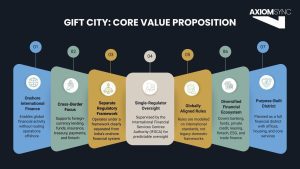
The idea behind GIFT City is not simply to create another business district. It is to carve out a jurisdiction that can support cross-border banking, investment, insurance, and financial services under a regulatory and tax framework that looks and feels familiar to global institutions, while remaining within India’s legal boundaries. In that sense, GIFT City is less about geography and more about jurisdictional design.
The city is divided into two zones – a Domestic Tariff Area, which functions like any other part of India, and a Special Economic Zone.
Within that SEZ sits the International Financial Services Centre, or IFSC. International financial services are permitted only within the IFSC, and entities operating there are subject to a different set of rules than those that apply in the domestic economy.
Firms operating in the IFSC are expected to deal primarily with non-residents, overseas investors, foreign counterparties, and cross-border transactions.
Business is conducted in foreign currency rather than Indian rupees, which immediately sets the IFSC apart from traditional Indian financial centres. This foreign-currency framework allows institutions to operate without many of the exchange-control constraints that apply onshore,and hence makes it viable to run international treasury operations, offshore-style funds, global insurance and reinsurance businesses, and cross-border payment platforms from within India.
Oversight of this ecosystem sits with the International Financial Services Centres Authority, or IFSCA.
Unlike India’s domestic system—where banking, securities, insurance, pensions, and payments are regulated by separate authorities—the IFSC operates under a single unified regulator. For firms, it means dealing with one authority for licensing, supervision, and regulatory engagement, a one-window regulatory clearance.
GIFT City did not grow in the way most commercial areas do.
It was planned upfront as a financial districtand that planning shows in practical ways. Core services are built into the layout rather than added later, utilities are largely out of sight, and systems such as cooling and power are designed to run continuously with minimal disruption. The expectation is reliability first, not adaptation after the fact.
The office buildings are designed for institutions that need stable infrastructure, secure access, and efficient layouts, rather than for generic commercial use. Beyond office space, the development includes housing, hotels, medical facilities, schools, and everyday retail. GIFT City is meant to function as a place where firms can base teams on a long-term basis, not just operate temporarily or for regulatory reasons.
It is equally important to be clear about what GIFT City is not.
It is not intended to replace Mumbai or compete with domestic Indian markets. Nor is it an unregulated offshore haven.Instead, it occupies a middle position: a tightly supervised, internationally aligned financial jurisdiction that happens to be located within India. Activities that are difficult or impractical to conduct in the domestic framework may be permitted in the IFSC, but only within clearly articulated regulatory boundaries.
Over time, GIFT City has moved beyond concept and policy intent into real operations. Banks conduct foreign-currency lending and trade finance. Fund managers launch structures that resemble offshore funds. Insurers and reinsurers underwrite international risk. Fintech firms test cross-border models. Multinational groups establish specialised financial service centres to support overseas operations. While the ecosystem is still developing, the range of activity already reflects the original ambition behind the IFSC.
At its core, GIFT City serves as India’s interface with global finance. It allows international institutions to engage with India-linked opportunities through a familiar regulatory lens, and it enables Indian firms to operate internationally without relocating to traditional offshore centres.
Why set up in GIFT City?
GIFT City offers a place to run international financial business without leaving the country. For decades, activities involving foreign currency, overseas investors, or cross-border structures were pushed offshore by default.
GIFT City was created to pull that activity back, not by relaxing oversight, but by redesigning the framework altogether.Since becoming operational, the IFSC has attracted a wide mix of institutions. Banks use it for foreign-currency lending and trade finance. Fund managers run India-linked strategies that would otherwise sit in traditional offshore centres. Insurers, reinsurers, payment firms, fintech platforms, leasing companies, and group treasury centres have followed. The common thread is not sector, but use case: these are activities that need to operate internationally, even when the underlying capital or risk is India-related.
Its location helps, but its real value lies in how it is positioned. Sitting between Ahmedabad and Gandhinagar, GIFT City remains close to India’s economic base while operating under a regime that is clearly separated from domestic financial rules.
Indian firms can service non-resident clients and manage cross-border flows without the usual onshore constraints. Foreign institutions can engage with India-linked opportunities without having to navigate the full complexity of India’s domestic regulatory system.Confidence in the IFSC has also been shaped by how it is regulated. Instead of multiple authorities with overlapping mandates, the entire ecosystem sits under a single regulator, the International Financial Services Centres Authority. For firms used to dealing with regulators in global financial centres, this makes a noticeable difference. Licensing paths are clearer, approvals are faster, and regulatory conversations tend to be more coordinated and predictable.
The regulatory framework itself reflects this intent. Rather than evolving slowly from legacy rules, IFSC regulations were designed with international alignment in mind from the outset. Fund management, banking, insurance, payments, fintech, leasing, and treasury operations are all covered under frameworks that borrow heavily from global practice, while still reflecting Indian policy priorities. For fund managers and fintech firms in particular, this balance between structure and flexibility has been a key draw.
Another reason GIFT City has gained traction is the sheer scale of capital linked to India.
The Indian diaspora, NRIs and OCIs, family offices, and global investors are increasingly looking for ways to access Indian assets through structures that meet international governance and compliance expectations.Operating in foreign currency, within a recognisable regulatory environment, makes the IFSC a natural fit for that demand. Tax efficiency plays a role, but it is rarely the only factor.
At the same time, GIFT City is not being shaped around a single product or theme. Alongside traditional banking and funds, the ecosystem has expanded into areas such as private credit, infrastructure and real-asset strategies, aircraft and ship leasing, ESG-linked services, trade finance platforms, and cross-border payments. The range of permitted activity suggests a deliberate attempt to build depth rather than rely on one narrow advantage.
GIFT City was planned as a working financial district
Not just a regulatory zone. Offices, housing, hotels, schools, healthcare, and everyday amenities sit within the same development. As more teams relocate, the city is gradually functioning less like a project site and more like a place where institutions can base operations for the long term.
Taken together, these factors explain the appeal of GIFT City. It is not simply a tax play or an experiment in regulatory arbitrage. For many firms, it has become the most straightforward way to run international financial business connected to India, without stepping outside India itself.
Specific advantages of establishing in GIFT City
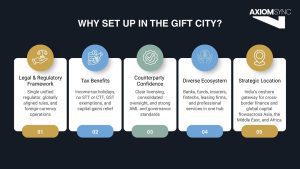
Legal and regulatory framework
-
Operates under a single, unified regulator – the International Financial Services Centres Authority (IFSCA)
-
Regulatory frameworks aligned with international financial centres rather than domestic Indian rules
-
Permits cross-border financial activities in foreign currency
-
Allows 100 percent foreign ownership for most financial and ancillary services
-
Simplified approval and supervision process compared to multi-regulator environments
Tax and fiscal benefits
-
100 percent income-tax exemption for any 20 consecutive years out of a 25-year block
-
No securities transaction tax (STT) or commodities transaction tax (CTT) on IFSC exchange trades
-
No GST on services received by IFSC units or on IFSC exchange transactions
-
Capital gains exemptions on specified securities listed on IFSC exchanges
-
Customs-duty exemptions on goods imported into the IFSC
Counterparty and investor confidence
-
Independent statutory regulator with consolidated oversight
-
Globally recognisable regulatory structure covering banking, funds, insurance, payments, and fintech
-
Clear licensing categories, net-worth requirements, and compliance obligations
-
Strong emphasis on AML, governance, and risk management aligned with international standards
Diverse and expanding ecosystem
-
Presence of international and Indian banks, fund managers, insurers, fintechs, and leasing companies
-
Rapidly growing fund domicile for India-linked offshore funds
-
Supportive environment for global capability centres and financial services outsourcing
-
Availability of professional services including legal, audit, compliance, and advisory firms
Strategic geographic and economic positioning
-
Acts as India’s offshore financial gateway without requiring relocation to a foreign jurisdiction
-
Enables participation in inbound and outbound capital flows linked to India
-
Supports India’s role in South-South trade and cross-border investment between Asia, the Middle East, and Africa
-
Well-positioned to benefit from long-term growth in emerging markets and global reallocation of capital
What is a Fund Management Entity?
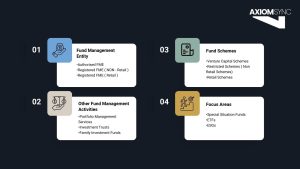
A Fund Management Entity (FME) is a registered entity under the IFSCA (Fund Management) Regulations, 2022, allowed to manage investments based on specific categories:
-
Authorized FME
-
Registered (Non-Retail) FME
-
Registered (Retail) FME
The IFSCA introduced these regulations to establish a robust yet streamlined regulatory regime for fund management activities within the center. The framework is based on the recommendations of an Expert Committee constituted in 2020 to promote venture capital and private equity activity in the IFSC, and is benchmarked against global best practices from jurisdictions such as Luxembourg, Singapore, and Ireland. It adopts a manager-centric approach, focusing regulatory oversight on fund managers while maintaining a light-touch regime at the fund level to enable operational flexibility and efficiency.
Fund Management Entities are organised into three categories, based on the activities permissible from the IFSC, and each category has a net-worth criteria.
FME Categories and Net Worth
|
Particulars |
Authorized FME |
Registered Non-Retail FME |
Registered Retail FME |
|
Net Worth |
$75,000 |
$500,000 |
$1,000,000 |
|
Permissible Activities |
Managing Family Investment Funds, Venture Capital Schemes (private placement). |
Managing Restricted Schemes, Portfolio Management Services (PMS), acting as investment manager for private placement REITs/InvITs, plus all Authorized FME activities. |
Managing Retail or Restricted Schemes, acting as investment manager for public REITs/InvITs, launching ETFs, plus all other FME activities. |
FME Fee Structure
|
Fee Type |
Amount |
|
Application Fee |
$2,500 |
|
Registration Fee (varies by category) |
$5,000 (Authorized) to $10,000 (Retail) |
|
Annual Fee (2nd year onwards) |
$2,000 |
Who is a Fund Manager?
A Fund Manager is an individual appointed by the FME to manage investments across approved asset classes and schemes.
Can a GIFT City–based Fund Management Entity serve clients in mainland India?
This is not permissible.
A GIFT IFSC–based Fund Management Entity is primarily designed to serve non-resident investors and offshore capital pools. Its ability to deal with mainland India (Domestic Tariff Area – DTA) clients is restricted by both IFSCA regulations and India’s FEMA framework.
FMEs can:
-
serve non-residents, NRIs, and offshore funds freely.
-
accept investments from Indian residents only under permitted routes, such as the Liberalised Remittance Scheme (LRS) or specific outbound investment frameworks.
Direct solicitation or management of onshore Indian client money (in INR) is not permitted unless the entity separately complies with SEBI / onshore regulatory requirements.
Indian investors investing into IFSC funds are effectively treated as making offshore investments, not domestic ones.
Can a Fund Management Entity based in GIFT City provide services to clients outside India?
Under the IFSCA framework, a Fund Management Entity in GIFT City is meant to operate like a fully-fledged international asset manager, just based in India. In practical terms, this means an FME can manage offshore capital, raise money from non‑resident investors, and run portfolio management, fund management, and advisory mandates for a wide range of global clients, including institutions, family offices, and high‑net‑worth individuals.
From an exchange‑control perspective, IFSC units are treated as non‑residents. That single point has big consequences: they can transact in foreign currencies as a matter of course and are not weighed down by many of the cross‑border restrictions that apply in the domestic Indian market. Put simply, a GIFT City FME gives you an offshore‑style asset management platform while you remain within India’s legal and tax ecosystem, and it can be used to implement both inbound and outbound investment strategies.
What kind of legal structures are available for Fund Management Entities in GIFT City?
In GIFT City, Fund Management Entities can only be set up through a defined set of legal structures under the IFSCA (Fund Management) Regulations, 2022. The “right” option in practice usually comes down to the category of FME you’re applying for and the kind of business you plan to run.
Broadly, an FME can be established as:
-
a company incorporated under the Companies Act, 2013
-
a Limited Liability Partnership (LLP) under the LLP Act, 2008
-
a branch of an existing Indian or foreign entity, if the regulator is comfortable with the parent and its oversight
In the market, a company limited by shares tends to be the default choice. It gives a clean separation between the fund platform and its owners, sits within a familiar corporate governance framework, and scales well as you add more funds, strategies, and investor classes. Both private and public companies are technically possible, but most managers opt for a private limited company because it is simpler to run.
An LLP is also on the menu, particularly for non‑retail FMEs, and it can work well when the business is tightly partner‑led and you want some operational flexibility. That said, an LLP still needs clear documentation around governance, partner accountability, and regulatory responsibilities. It is also worth keeping in mind that LLPs are not permitted for Registered (Retail) FMEs, so they are not a universal solution.
Some groups prefer to operate through a branch of an existing regulated entity. This can be an Indian or foreign parent, but in either case the parent must already be supervised by a recognised financial regulator and must meet IFSCA expectations on substance, governance, and financial strength. Branch setups tend to attract closer scrutiny, and the regulator will expect to see robust oversight and control arrangements between the IFSC unit and the head office.
In many cases, FMEs are ultimately set up as subsidiaries of Indian or foreign parent entities using the company structure. This is often the cleanest fit when the GIFT City platform is meant to sit within a larger regional or global asset management or financial services group.
What are the custodian requirements for FMEs?
As a general rule, the IFSCA (Fund Management) Regulations require FMEs to appoint a custodian that is registered with the IFSCA to hold and administer scheme assets. The idea is straightforward: investor assets should be ring‑fenced, properly safeguarded, and subject to independent oversight.
There are, however, a few carve‑outs. Fund‑of‑funds structures are not required to appoint an IFSC custodian, and where the scheme invests into securities issued in a foreign market, the manager can use a suitably regulated local custodian in that jurisdiction instead.
What currencies are permitted for transactions?
All units operating in the International Financial Services Centre (IFSC) at GIFT City are required to conduct their business activities in
permissible foreign currenciesOther than the Indian Rupee. To this end, such units are required to open and maintain
foreign currency accounts with banks operating within the IFSC at GIFT City. Financial institutions established in the IFSC, being treated as
persons resident outside Indiafor exchange-control purposes, are permitted to open and maintain a
Special Non-Resident Rupee (SNRR) accountwith a bank in India, outside the IFSC, in accordance with the Foreign Exchange Management (Deposits) Regulations, 2016. Such SNRR accounts
may be used solely for meeting expenses denominated in Indian Rupees and incurred outside GIFT City and the IFSC.The International Financial Services Centres Authority has notified the following
specified foreign currenciesas permissible for undertaking business in the IFSC at GIFT City:
US Dollar (USD), Euro (EUR), Pound Sterling (GBP), Japanese Yen (JPY), Swiss Franc (CHF), Singapore Dollar (SGD), Australian Dollar (AUD), Canadian Dollar (CAD), Hong Kong Dollar (HKD), UAE Dirham (AED), Russian Rouble (RUB), Swedish Krona (SEK), Danish Krone (DKK), Norwegian Krone (NOK), and New Zealand Dollar (NZD).
What are the minimum personnel requirements for an FME in GIFT City?
The IFSCA (TechFin and Ancillary Services) Regulations, 2025 do not set a hard minimum headcount for ancillary service providers. Instead of asking you to hit a specific number of employees, the regulator focuses on whether the firm has real substance on the ground, clear lines of responsibility, and people who actually know what they are doing.
In day‑to‑day terms, the Authority looks first at who is in charge. It expects the entity to identify individuals who are genuinely responsible for the business and who have the right mix of qualifications and experience to run and oversee the proposed services. At the very least, an ancillary service provider is expected to appoint:
-
a Principal Officer, who takes overall responsibility for the conduct and management of the business; and
-
a Compliance Officer, who looks after regulatory compliance, internal controls, record‑keeping, and the firm’s reporting to the IFSCA.
These are not meant to be paper titles. The regulator expects these roles to be substantive, held by people with sufficient seniority and relevant background, and with real oversight of the IFSC operations.
There is still no prescribed minimum team size beyond this, but the staffing has to make sense for the business. The number and profile of employees should match the scale, complexity, and risk of the services being provided. When assessing an application or reviewing an existing licensee, the IFSCA will look at whether the firm has enough people to deliver its services in a controlled and compliant way, including appropriate segregation of duties where that is needed.
In practice, the Authority also expects that anyone delivering specialist services—such as legal, compliance, accounting, or tax support—is properly qualified and experienced in that particular area. A very lean team is not necessarily a problem, but a lean team without the right skills or clear accountability usually is.
Overall, the focus is not on ticking a “minimum headcount” box. What matters to the regulator is whether the ancillary service provider can demonstrate credible operational capability, sound governance, and genuine regulatory readiness for the business model it is proposing.
Organisational structure, governance, and presence in the IFSC
Beyond staffing, the IFSCA also looks closely at how the firm is organised. It assesses the operational structure, reporting lines, and how decisions are actually made within the business. The question is whether the setup supports proper oversight and control, rather than being a formality on paper.
Equally, the Authority wants to see that the provider is truly operating out of the IFSC on an ongoing basis, not just maintaining a nominal presence. This is why it repeatedly emphasises clear accountability for key roles and a genuine on‑ground presence within GIFT City, rather than a purely remote or “brass‑plate” model.
What are the key tax benefits available to firms in GIFT City?
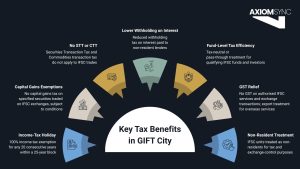
The tax framework in GIFT City is best understood as a set of targeted concessions rather than a standalone tax regime. Entities operating in the IFSC remain within India’s income-tax system, but specific incentives are layered on top to make international financial activity viable onshore. The focus is on foreign-currency business, cross-border services, and India-linked offshore activity that would otherwise sit outside the country.
One of the central incentives is the income-tax holiday available to IFSC units. Eligible entities can claim a full exemption from income tax for ten consecutive years, chosen by the taxpayer, within a broader fifteen-year window.
This flexibility allows firms to defer the exemption until operations stabilise or profitability improves, rather than being forced to use it from day one. The exemption applies only to income earned from approved IFSC activities and does not extend to unrelated or domestic operations.
Capital markets activity in the IFSC benefits from a separate set of concessions.
Capital gains arising from transfers of specified securities listed on IFSC exchanges are exempt from tax, subject to prescribed conditions. In addition,
transactions executed on IFSC exchanges are not subject to securities transaction tax or commodities transaction tax. For trading desks, funds, and institutional investors, this materially reduces transaction costs and aligns the IFSC more closely with offshore exchanges.
The regime also addresses cross-border funding efficiency.
Interest payments made by IFSC units to non-resident lenders are subject to concessional withholding tax rates, improving the economics of offshore borrowing.This is particularly relevant for banking units, leasing companies, and treasury centres that rely on international debt markets.
For funds established in the IFSC, the tax framework is designed to minimise leakage at the fund level.
Certain funds benefit from tax-neutral or pass-through treatment, and eligible non-resident investors may be exempt from capital gains tax on transfers of fund units, subject to conditions.This makes GIFT City a workable domicile for India-focused offshore funds without forcing managers or investors into complex multi-jurisdictional structures.
Indirect taxes are also addressed. I
FSC units are generally exempt from GST on services received for authorised operationsand transactions carried out on IFSC exchanges are similarly relieved from indirect tax.
Where services are provided to overseas clients, they are typically treated as exports for GST purposes, provided the statutory conditions are met.This reduces the operating cost base for firms using the IFSC as an export hub for financial or professional services.
Finally, for tax and exchange-control purposes, IFSC units are largely treated as non-residents. This classification supports the foreign-currency operating model and complements the direct-tax incentives by allowing greater flexibility in cross-border structuring, treasury activity, and group support arrangements.
Summary of key tax benefits in GIFT City
|
Area |
Tax treatment in GIFT City (IFSC) |
|
Income tax |
100% income-tax exemption for any 20 consecutive years out of a 25-year block, for eligible IFSC income |
|
Capital gains |
Exemption on capital gains from transfer of specified securities listed on IFSC exchanges (subject to conditions) |
|
STT / CTT |
No securities transaction tax or commodities transaction tax on IFSC exchange transactions |
|
Withholding tax |
Concessional withholding tax rates on certain interest payments to non-residents |
|
Funds |
Tax-neutral / pass-through treatment for eligible funds; capital gains exemptions for certain non-resident investors |
|
GST / indirect tax |
GST exemption on services received for authorised operations; IFSC exchange transactions exempt |
|
Export of services |
Services provided to overseas clients generally treated as exports, subject to GST conditions |
|
Residency status |
IFSC units treated as non-residents for tax and exchange-control purposes |
How much does it cost to set up a Fund Management Entity in GIFT City?
The cost of establishing a Fund Management Entity (FME) in GIFT City depends on the category of FME (Authorized, Registered Non-Retail, or Registered Retail), the scope of activities, and the level of operational substance maintained in the IFSC. Unlike ancillary service providers, FMEs are regulated financial entities and are subject to
minimum net worth requirements, higher regulatory fees, and more robust governance expectations. GIFT City is positioned as an international financial centre, and the cost structure reflects the need for credible, well-capitalised fund management platforms.
-
IFSCA application, registration, and annual fees (official)
FMEs are registered with the IFSCA under the Fund Management Regulations. The indicative fee structure is:
-
Application fee: USD 2,500 (one-time)
-
Registration fee: USD 5,000 (Authorized FME) to USD 10,000 (Retail FME)
-
Annual fee: Approximately USD 2,000 from the second year onwards
These are fixed regulatory fees and do not vary based on AUM in the initial stages.
-
Minimum net worth / capital requirements
FMEs must meet prescribed minimum net worth thresholds, depending on category:
-
Authorized FME: USD 75,000
-
Registered (Non-Retail) FME: USD 500,000
-
Registered (Retail) FME: USD 1,000,000
This is a core differentiator from ancillary service providers and represents a significant portion of the initial setup commitment.
-
Entity incorporation and SEZ onboarding (one-time)
FMEs must establish an IFSC unit (typically a company structure) and complete SEZ onboarding requirements. Indicative costs include:
-
Incorporation and structuring: USD 2,000 – 5,000
-
SEZ approvals, PLOA, and documentation: USD 3,000 – 6,000
Indicative total (one-time, excluding capital):
USD 5,000 – 11,000
-
Office space and operational presence
FMEs are expected to maintain a meaningful presence in GIFT City, including key personnel:
-
Grade-A office rent: USD 12 – 18 per sq ft per month
-
Typical office setup: USD 10,000 – 25,000 per year
-
Fit-out and infrastructure: USD 15,000 – 40,000 (one-time)
-
Professional and advisory costs (one-time)
FME applications are more complex than ancillary registrations and require detailed regulatory documentation:
-
Advisory and application support: USD 15,000 – 40,000+
(depending on structure, strategy, and regulatory engagement)
-
Ongoing annual operating costs
Recurring costs include:
-
IFSCA annual fee: ~USD 2,000
-
Audit, accounting, and compliance: USD 10,000 – 25,000
-
Key personnel (fund manager, compliance, operations): USD 80,000 – 200,000+
-
Custodian, administration, and service providers: variable based on AUM
-
Technology and infrastructure: USD 10,000 – 30,000
Indicative annual run-rate:
USD 120,000 – 300,000+, depending on scale and team structure
Summary table – Ancillary Service Provider costs in GIFT City
|
Cost category |
Indicative cost (USD) |
|
IFSCA application fee |
2,500 (one-time) |
|
IFSCA registration fee |
5,000 – 10,000 (one-time, depending on FME category) |
|
IFSCA annual fee |
~2,000 per year |
|
Minimum net worth / capital |
75,000 – 1,000,000 (depending on FME category) |
|
Incorporation + SEZ setup |
5,000 – 11,000 (one-time) |
|
Office rent (annual) |
10,000 – 25,000 |
|
Fit-out and furnishing |
15,000 – 40,000 (one-time) |
|
Advisory and setup support |
15,000 – 40,000+ (one-time) |
“All cost figures are indicative only and are based on applicable IFSCA regulations, publicly available fee schedules, and prevailing market practice as of 2025. Actual costs may vary depending on the nature, scale, and regulatory classification of the business.”
How can AxiomSync help you establish and maintain your presence in the GIFT City?
AxiomSync is a registered
Ancillary Service Provider with the International Financial Services Centres Authority (IFSCA)and forms part of the
10 Leaves GroupA cross-jurisdictional legal, compliance, and financial advisory platform headquartered in Dubai, UAE. The group maintains established regulatory and operational capabilities across
DIFC, ADGM, Luxembourg, Mauritius, and IndiaEnabling it to support clients with international structures that intersect multiple regulatory regimes.
With a team of over
50 specialised professionalspning compliance, legal advisory, risk management, regulatory licensing, and operational setup, AxiomSync provides
end-to-end supportto firms seeking to establish, license, and operate businesses from GIFT City IFSC. Its services are designed to align with the IFSCA regulatory framework while remaining practical, implementation-focused, and scalable.
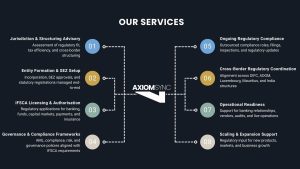
1. Jurisdictional assessment and structuring advisory
Before incorporation or licensing, AxiomSync supports clients in determining whether GIFT City is the appropriate jurisdiction for their proposed business model. This includes comparative analysis against other international financial centres such as DIFC and ADGM, assessment of regulatory fit, tax considerations, and operational substance requirements.
Services include:
-
Business-model suitability assessment for GIFT City
-
Regulatory perimeter analysis under IFSCA regulations
-
Cross-jurisdiction structuring involving DIFC, ADGM, Luxembourg, or Mauritius
-
Holding, fund, treasury, or platform structuring for India-linked international activity
This upfront advisory ensures that clients enter the IFSC with a structure that is viable both commercially and regulatorily.
2. Entity formation and SEZ setup support
AxiomSync manages the complete
entity setup processwithin GIFT City, coordinating incorporation, SEZ approvals, and statutory registrations through the
SWIT portaland related authorities.
This includes:
-
Assistance with office identification and SEZ documentation
-
Provisional Letter of Approval (PLOA) support
-
Company or LLP incorporation in India for IFSC purposes
-
Execution of bond-cum-legal undertaking with SEZ and customs authorities
-
GST and Import Export Code (IEC) registrations, where applicable
The focus is on ensuring that legal formation, SEZ compliance, and regulatory readiness progress in parallel.
3. IFSCA licensing and regulatory authorisation
As an IFSCA-registered Ancillary Service Provider, AxiomSync provides
hands-on regulatory licensing supportacross all major IFSC business categories.
This includes assistance with:
-
IFSC Banking Unit-related advisory (non-bank participants and group interfaces)
-
Finance Company registrations (including lending, trade finance, factoring, forfaiting, leasing, ITFS participation)
-
Fund Management Entity (FME) registration and fund launches
-
Capital Market Intermediary licensing (brokers, advisers, custodians, distributors)
-
Payment Services authorisation and sandbox participation
-
Insurance and reinsurance office applications
Support covers preparation of regulatory applications, business plans, financial projections, governance frameworks, and ongoing engagement with the IFSCA through the application lifecycle.
4. Governance, compliance, and AML framework design
AxiomSync designs and implements
IFSCA-aligned governance and compliance frameworkstailored to the client’s regulatory category and risk profile.
Services include:
-
Drafting of compliance manuals and regulatory policies aligned with applicable IFSCA regulations
-
AML, CFT, and KYC frameworks compliant with IFSCA AML Guidelines
-
Risk management frameworks and internal control policies
-
Board and management governance structures
-
Outsourcing, data protection, and business continuity policies
These frameworks are designed not just for approval, but for
actual operational use, inspection readiness, and scalability.
5. Ongoing compliance and regulatory support
Beyond licensing, AxiomSync provides
ongoing compliance supportto IFSC entities operating in GIFT City, either on a retained or modular basis.
This includes:
-
Outsourced or co-sourced Compliance Officer and AML Officer support
-
Regulatory reporting and filing assistance
-
Support during IFSCA supervisory reviews and inspections
-
Ongoing monitoring of regulatory changes and impact assessments
-
Periodic compliance health checks and gap analyses
This allows clients to maintain regulatory continuity without over-building in-house teams in the early stages.
6. Cross-border legal and regulatory coordination
Many GIFT City structures sit alongside entities in other jurisdictions. Through the 10 Leaves Group, AxiomSync coordinates
cross-border legal and compliance alignmentacross DIFC, ADGM, Luxembourg, Mauritius, and India.
This includes:
-
Group-level compliance and governance harmonisation
-
Regulatory mapping across multiple jurisdictions
-
Support for India-linked global fund and treasury structures
-
Assistance with regulator-to-regulator consistency and disclosures
This capability is particularly relevant for multinational groups, fund sponsors, family offices, and fintech platforms operating across regions.
7. Operational readiness and scaling support
Once licensed, AxiomSync assists clients in moving from regulatory approval to
live operations and growth.This includes:
-
Support with IFSC banking relationships and operational accounts
-
Assistance with onboarding service providers and vendors
-
Regulatory input on new products, services, or geographic expansion
-
Preparation for audits, investor due diligence, and counterparties
The objective is to ensure that IFSC entities are not only compliant on paper, but
operationally credible and scalable.Positioning within the GIFT City ecosystem
Through its registration with the IFSCA and its integration within the wider 10 Leaves Group, AxiomSync operates as a
long-term advisory partnerrather than a one-time setup provider. Its role is to bridge regulatory intent with commercial reality, helping clients navigate the IFSC framework with clarity, discipline, and foresight.

